


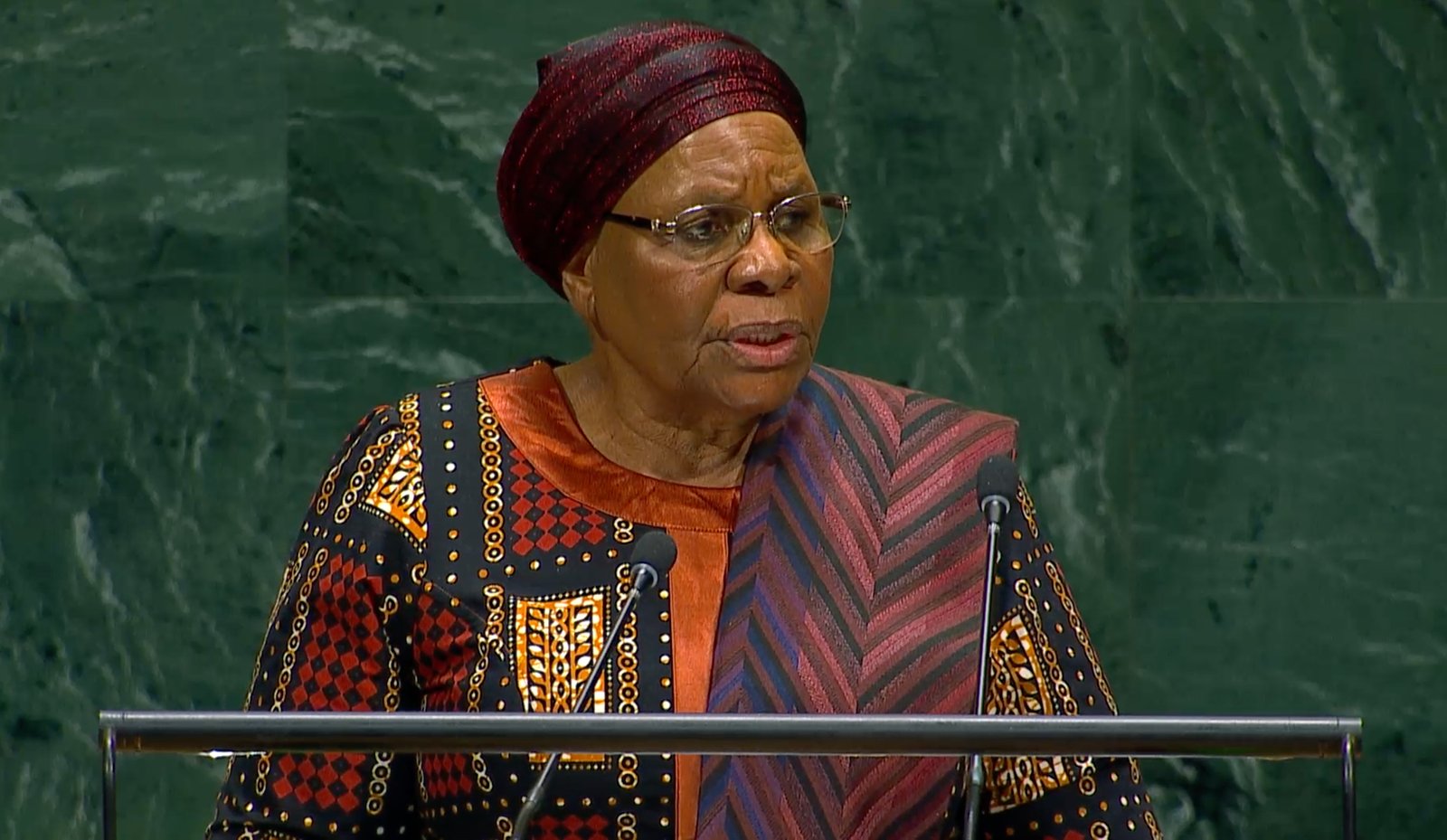
Netumbo Nandi-Ndaitwah, President of Namibia, noted the country was born out of international solidarity. “Therefore, we shall not be passive observers to efforts aimed at dismantling or weakening the international system, that has served us over 80 years, albeit with some shortcomings.”
She called for “peace over conflict, dialogue over confrontation and peaceful coexistence over tensions”.
As well she called for critical reform of the international financial architecture, welcoming the creation of the African Credit Rating Agency to be launched in Mauritius in October — “a building block of Africa taking ownership of her development and prosperity agenda”.
Turning to climate, she warned that increasing devastating floods, relentless heatwaves, frequent hurricanes and prolonged periods of drought mean “at times, it feels that we are at war with Mother Nature”.
Namibia contributes less than 0.01 per cent of global greenhouse gas emissions yet it bears a disproportionate share of the impacts of climate change, like other developing countries. She therefore called for “greater responsibility by those that have contributed most to global greenhouse gas emissions” — including through sustainable climate financing.
Urging a focus on water in 2026, she noted that Namibia, an arid country, will host the Global Water Partnership Headquarters, located in the Global South for the first time.
Recalling Namibia’s historical experience of the brutality of colonialism, apartheid and occupation, she urged full implementation of Council resolution 2797 (2025), reaffirming the need for a mutually agreeable lasting political solution between the Polisario Front and Morocco.
Also recalling adoption of the Assembly’s resolution on the Transatlantic Slave Trade in March 2026, she called it “the beginning of a journey towards truth, acknowledgement, healing and justice for millions of Africans and people of African descent, whose lives were forever changed by slavery, colonialism and other historic injustices”.